
The article has been authored by Jayatu Chaudhury, Professor, Finance and Accounting, IMI Delhi
Investors today face persistent uncertainty driven by geopolitical conflicts, inflation, rising interest rates, currency fluctuations and volatile markets. While every market correction fuels predictions about what comes next, history shows that consistently forecasting short-term market movements is extremely difficult.
Rather than trying to predict the next crisis, investors should focus on what they can control: building a portfolio that can withstand uncertainty while creating long-term wealth. The answer lies not in market timing or stock picking, but in thoughtful asset allocation and diversification.
The New Importance of Asset Allocation
Indian investors have traditionally relied heavily on domestic equities for wealth creation. While this strategy has benefited from India’s long-term growth, the period between 2011 and 2026 demonstrated that even strong markets can experience prolonged volatility driven by events beyond investors’ control.
Demonetisation, GST, the Covid-19 pandemic, aggressive interest-rate hikes, the Russia–Ukraine conflict, inflation shocks and geopolitical tensions reinforced one key lesson: no single asset class performs well in every economic environment.
Equities drive long-term growth, bonds provide stability during periods of stress, and gold offers protection against inflation and geopolitical uncertainty. Together, they create a more resilient portfolio than any single asset class alone.
What Fifteen Years of Data Revealed
To evaluate different asset allocation strategies, we analysed fifteen years of historical data (2011–2026) covering Indian equities, international equities, gold and government securities. Five portfolio models were assessed under both lump sum and SIP investing using CAGR/XIRR, volatility, Sharpe Ratio, maximum drawdown and terminal wealth as performance measures.
The Allocations considered were as follows:
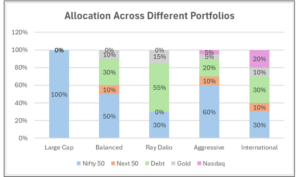
Two investment scenarios were then evaluated:
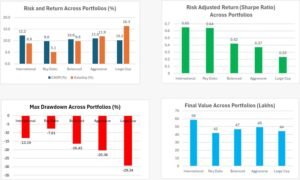
1. A lump sum investment of ₹10 lakh made in January 2011
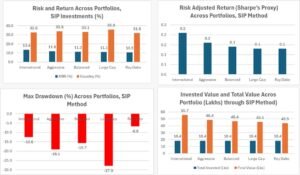
2. A monthly SIP investment of ₹10,000 over the same period
This ensured the analysis moved beyond simple return comparisons and instead focused on risk-adjusted investing outcomes across multiple economic cycles. The results are provided below. For the Lumpsum Portfolio, the results are provided below.
For SIP Method, the results are provided below.
The Evidence: Diversification Works
The findings were remarkably consistent. Portfolios diversified across multiple asset classes consistently outperformed portfolios concentrated solely in Indian large-cap equities on a risk-adjusted basis. They delivered competitive long-term returns while experiencing significantly lower volatility and smaller drawdowns during periods of market stress.
The internationally diversified portfolio emerged as the strongest performer. Exposure to global equities, gold and government securities cushioned market downturns, allowing investors to remain invested through multiple crises.
The message is clear: long-term investment success depends as much on asset allocation as on asset selection.
The Complementary Roles of Gold, Equities and Bonds
Each asset class serves a distinct purpose within a portfolio.
● Equities drive long-term wealth creation but are also the most volatile.
● Government bonds provide stability during economic slowdowns and market stress.
● Gold acts as a hedge against inflation, geopolitical uncertainty and financial market turbulence.
Rather than competing, these assets complement one another. When one underperforms, another often provides stability, reducing overall portfolio risk.
Behaviour Matters as Much as Asset Allocation
Even a well-diversified portfolio can fail if investors abandon it during market corrections.
The biggest challenge in investing is often behavioural. Investors tend to become overly optimistic during bull markets and excessively pessimistic during downturns, leading them to buy high and sell low. Those who remain disciplined and continue investing through market cycles are better positioned to benefit from long-term compounding.
Our analysis also showed that while SIPs improve investing discipline and reduce timing risk, asset allocation had a greater impact on long-term outcomes than the choice between SIP and lump sum investing. Portfolio construction mattered more than the investment method itself.
Building Resilient Portfolios
As uncertainty becomes a permanent feature of financial markets, investors need to move beyond concentrating wealth in a single asset class. A resilient portfolio is not designed to maximise returns every year, but to perform consistently across different market environments. Diversification across equities, bonds and gold reduces volatility, limits drawdowns and improves the likelihood of long-term wealth creation.
The lesson from the past fifteen years is simple. Investors cannot control inflation, interest rates, geopolitical events or market sentiment. They can control how they allocate their capital. In an uncertain world, successful investing is less about predicting the next crisis and more about building a portfolio capable of surviving it.