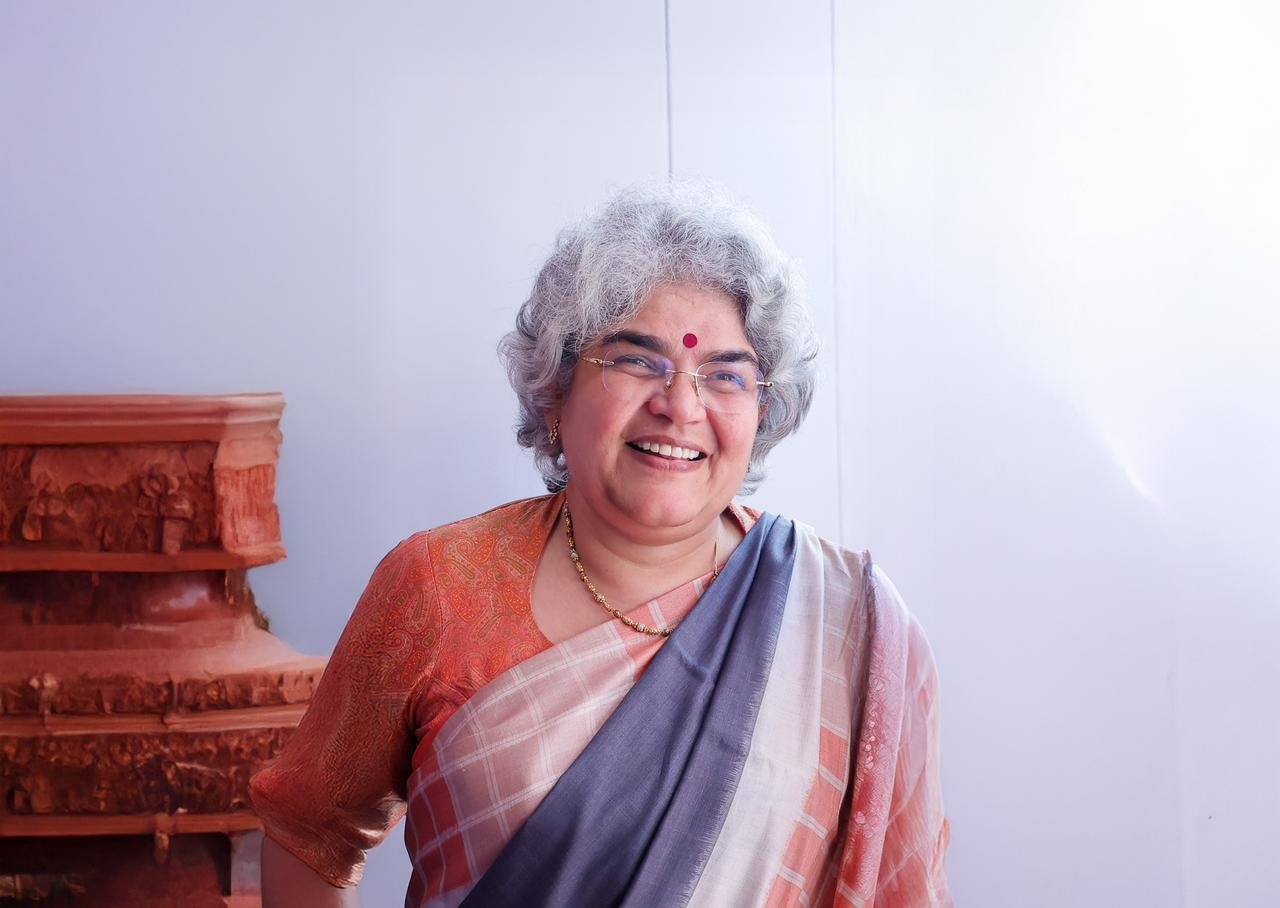
In 2006, a young carpenter working beneath a flyover told Dr. Gayathri Vasudevan something that no policy paper had. He was skilled and willing, and he was already working, but no one would pay him what he was worth because nothing could vouch for what he knew.
For Vasudevan, then a veteran of the International Labour Organization with years spent on labour policy, gender-transformative skilling and the informal economy, it was the missing piece. A skill, she realised, does not become income on its own. It needs recognition, employer trust and a system of support around the worker.
That insight became Sambhav Foundation, which she founded and now chairs. Twenty years on, the organisation is built on a simple rejection of the industry’s favourite scoreboard: the number of certificates issued. In this conversation with Wealth Spark, Vasudevan looks back at the early years, when the model was unproven and the failures were specific and instructive, and explains why she chose to measure what happens after training rather than the training itself.
Q1. Take me back to 2006: what was the moment or experience that made you say, “I need to start Sambhav”? What were you doing before this?
In 2006, I met a young carpenter called Raju who was working under a flyover. I remember speaking to him and asking about his work. He was skilled at what he did, but he told me that people did not trust him enough to pay him well because there was nothing that could prove what he knew or what he was capable of.
That conversation stayed with me. I had spent quite a few years at the International Labour Organization, working on labour policy, gender-transformative skilling and the informal economy. I had seen the larger systems and policies, but this interaction made the issue very real for me. Here was a young person who had a skill, was willing to work, and was already working, yet that skill was not translating into the income or dignity it should have.
I kept thinking about that gap. We often talk about skilling as if teaching someone a skill is the end of the process. For me, Raju made it clear that it was only the beginning. A person also needs recognition, employer trust, and the support to turn that capability into a livelihood.
That was the idea I wanted to build around when I started Sambhav. I did not want to create another organisation that simply trained people and counted how many certificates were issued. I wanted to understand what had to exist around a person for a skill to actually change their economic life. That question has continued to shape how we work at Sambhav even today.
Q2. Two decades is a long time to stay committed to one mission. What kept you going in the early years when the model wasn’t yet proven?
There were years when we had no real evidence that any of this worked, just a conviction that training people without addressing what surrounded them was not going to hold. What kept me going was watching it fail in small, specific ways, and learning from each failure instead of walking away from it. A batch of workers would get certified and still not get hired, or get hired and quit within weeks, and each time that happened, we would go back and ask what was missing: family buy-in, safety, a support system at the workplace. Slowly those answers started forming into something structural.
I did not have the language for “systems-led” back then; I just knew that counting certificates handed out was the wrong scoreboard, and I was not willing to build an organisation around the wrong number.
Q3. Was there a personal encounter a person, a family, a community that shaped how you think about “inclusion by design” rather than treating it as an afterthought?
Saadhya, our very first initiative, came out of exactly this kind of encounter, with families of neurodivergent and disabled individuals who had been told, in some form, that mainstream education was not built for their child. Not maliciously, just as a fact of how schools were designed. Watching a parent brace for that rejection before even asking the question told me everything about what “inclusion” usually means in practice – a special accommodation requested after the fact, granted or denied at someone else’s discretion.
Building Saadhya meant starting from the opposite instinct, designing the learning environment around the child with the highest barrier to participation first, and letting everyone else fit into that. That principle did not stay confined to one school. It is the same lens we now bring to adult skilling and workplace readiness across Sambhav.
Q4. Saadhya is described as your “maiden intervention”, a school for neurodivergent and disabled learners. Why did you choose to start there, at what many would consider the hardest starting point, rather than with something more “scalable”?
When you design for the person who has the least room to adapt to a broken system, you end up fixing things that were broken for everyone, not just for them. That is really the calculation behind starting with Saadhya.
Had we started with an easier population and tried to retrofit inclusion later, we would have built our habits around what is convenient, not what is necessary. Inclusion almost always gets cut first unintentionally when it is treated as an add-on under pressure. Starting with the hardest case forced us to get the fundamentals right early, on dignity, accessibility, and retention, because there was no shortcut available. Those fundamentals turned out to be transferable. The same discipline now shapes how we design workplace readiness and adult skilling programmes across Sambhav, for populations far removed from Saadhya’s original classroom.
Q5. You moved from standalone skilling programmes to a systems-led cluster model. What was the breaking point the data point or the field visit that told you training alone wasn’t enough?
There was no single moment; it was a pattern that kept repeating until we could no longer ignore it.
Certification numbers kept climbing year on year, but when we went back and tracked what happened to people six months or a year after placement, retention and income mobility stayed fragile. Someone would get placed in one cluster and thrive, and the same training, delivered the same way, would produce almost no lasting outcome in another, simply because that second location had no enterprise ecosystem, no local employer relationships, nothing for that person to grow into once the initial job ended or the season changed. That told us the problem was never really about the quality of the training. It was that we were dropping a trained individual into a vacuum and hoping the surrounding economy would absorb them on its own.
The cluster model came directly out of that realisation. We understood that a school, a skilling centre, a local enterprise, and a community support system all had to exist in the same geography, working together, for training to convert into something durable.
Q6. What did failure look like in those early project-based years? Can you share a specific story of a learner who got trained but didn’t get sustained livelihood and how that changed your approach?
A young tailoring graduate from one of our first batches left her job within two months of being placed. She had done well in training. The unit that hired her had no complaints about her work. On our records, she counted as a successful placement – and that’s where it stopped.
When we actually went and asked her why she left, none of it had anything to do with her skill. Nobody at the workplace helped her settle in, the commute home after her shift was not safe, and her family had agreed to let her take the job without ever really being part of that decision. We had trained her and had left everything else to chance.
After we noticed this as a recurring pattern among trainees, we realised we needed to focus on the grassroots issues just as much. It was truly a wake-up call for us. Today, these situations have been anticipated and built into our line items.
Q7. How did you convince your own team and your funders to move away from placement numbers as the primary success metric?
The data did most of the convincing, once we started tracking people well past their placement date.
For years, everyone, us included, reported placement as the headline number because it was the most obvious thing to count and the most evident thing for a funder to put in their own annual report as RoI. Proposing that we track people six and twelve months after placement meant our own numbers might look less polished before they looked better, and that took some internal conviction to sit with.
What actually shifted things was showing funders retention and income progression data alongside placement figures, side by side, so they could see for themselves that a high placement number with poor retention was not the full success story; it was a gap we had not been measuring yet. Once a few funders started asking for that fuller picture on their own, it stopped being something we had to advocate for internally and became the standard everyone expected to see.
Q8. Walk me through what actually happens inside a “cluster” if I visited one tomorrow; what would I see that I wouldn’t see in a typical NGO-run skilling centre?
A cluster is a defined geography we target for certain interventions. Currently, we work across 64 of them, where we build several ‘institutions’ to work together to meet a larger objective. The focus is not to run a single intervention and move on.
A typical skilling centre visit shows you a classroom, a batch of trainees, and a trainer. Instead, a walk through one of our clusters would show you several skilling centres and solution hubs focused on different trades to meet what the local population and economy need. For example, beauty and wellness training might run in one part of the cluster, green and EV skilling in another, tailoring and enterprise incubation somewhere else, depending on what that specific region and population can realistically absorb.
You would also see the market linkage work happening before anyone graduates. A local employer relationship gets built while a batch is still training, not after, so placement is not a cold search once someone is certified. It is a hyperlocal match we have already set up. Someone choosing enterprise over a job gets a similar head start, with real buyer connections and market orders lined up, rather than just a certificate.
The piece most visitors do not expect is the infrastructure work sitting quietly underneath all of this: schools we have strengthened, health access we have built into the same geography. These exist because a family’s progress rarely survives one bad shock. An illness with nowhere nearby to treat it, or a school unsafe enough that a child drops out, can undo months of livelihood work in one stroke. A cluster is designed so the community itself can absorb those shocks locally, instead of every setback starting the family’s progress over from zero.
Q9. Tell me about a woman or young person from the Saamuhika Shakti or green-skilling programmes whose journey has stayed with you personally.
Sangeetha, a 21-year-old resident of Lakshmidevi Nagar in Bengaluru, is the eldest of four siblings in a family that has long been part of the city’s informal waste management sector. Her parents work at a waste segregation centre, sorting recyclable materials to sustain the household. Despite the financial pressures, Sangeetha managed to complete her Bachelor of Arts from a local government college, an achievement in itself given her background.
In 2024, seeking a way to contribute to her family’s income, she enrolled in the Retail Sales Associate course offered by Sambhav Foundation at the Gorguntepalya Livelihood Resource Centre. The course focused on workplace communication, customer service, and essential digital literacy. For Sangeetha, it was also her first exposure to structured skill-building. She credits her trainers and peers at Sambhav for helping her gain the confidence to look beyond traditional roles.
It was during this time that an opportunity opened up through Social Alpha, an innovation platform that supports startups solving social and environmental challenges. Social Alpha’s support to Sambhav Foundation helped create a bridge between training and employment by enabling placements within the climate-tech ecosystem. One of these startups, Kosha AI, was looking for entry-level talent for its pilot project on FibreSENSE, a portable device that identifies fabric composition using near-infrared technology.
Sangeetha was placed at Kosha AI as a Quality Checker and became part of the team visiting Textile Recovery Facilities (TRFs) to demonstrate and test the FibreSENSE device. This marked a significant shift from her family’s traditional role in waste segregation into a more formalised, skilled role in the textile recycling value chain.
To ensure her success, Kosha provided Sangeetha with upskilling support that included training in spoken English, Microsoft Excel and Word, and data entry, skills that allow her to interact professionally with customers and document test results during field visits. Today, she earns a stable monthly income at the starting stage of her career, which not only supports her family financially but also helps her envision a more secure future. As FibreSENSE continues to be piloted across TRFs, Sangeetha’s work also contributes to solving a major gap (accurate fabric identification) in the textile recycling industry.
Her story is one example of a shift happening in the circular economy, where daughters of informal workers are finding their way into tech-enabled, skilled roles in the very ecosystem their parents helped sustain. While her parents continue to work in waste segregation, Sangeetha’s upward mobility demonstrates the transformative potential of vocational training and inclusive hiring.
Q 10. You’re entering your third decade. What does Sambhav look like in 2036? Is the goal to grow bigger, or to make yourselves unnecessary in more places?
Growing bigger was never really the ambition on its own; becoming unnecessary in specific places is. We already define success at the cluster level as the point where a geography no longer depends on us for momentum. The schools, the skilling centres, the local employers, and the community institutions carry it forward themselves. By 2036, I would want a meaningful number of our current clusters to have reached exactly that point, no longer needing Sambhav as an active presence, while we move that same model and the lessons from it into newer, less served geographies.
So yes, the overall footprint should grow to cover more states and more communities. But the real marker of success is how many places we can afford to leave behind, in the best possible sense, because the systems we built there are running on their own. Bigger in reach, smaller in dependency, that is the version of scale I actually care about.
Q11. If you had to boil down everything you’ve learned in twenty years into one piece of advice for someone starting a development-sector organisation today, what would it be?
Do not let the easiest number to report become the number you actually optimise for. Certificates issued, people trained, beneficiaries reached- these are simple to count. They are also simple to put in a funding proposal. That is exactly why they end up driving decisions long after they have stopped meaning very much. That pull to report the obvious does not go away on its own. It has to be actively resisted.
The harder, more useful questions such as whether someone’s income actually improved a year later, whether they stayed in a job or grew out of it into something better, or whether a family’s circumstances genuinely shifted, take much longer to answer. They also rarely look impressive in a single annual report, especially in year one or two. Build your systems to track those harder questions from day one anyway, even knowing the early answers will probably be unflattering. It will cost you a harder time, possibly, with a funder who wants a tidy win to showcase quickly. But it is the only way to build something that still holds up twenty years on.